The Fact Finder
A Fact-checking and AI/Media Literacy Web Game | Spring 2024
Introduction
Collaborators | Pin-Chun Lu; Taiwan FactCheck Center
Fact Finder is an interactive web-based mini game designed to improve AI literacy and media literacy by teaching users how to verify information, recognize misinformation, and understand fact-checking processes through hands-on practice.
Fact Finder is an interactive web-based mini game designed to improve AI literacy and media literacy by teaching users how to verify information, recognize misinformation, and understand fact-checking processes through hands-on practice.

01 Empathize — Understanding the Literacy Gap
Through interviews and early testing with young users (ages 15–25), we observed several recurring attitudes toward misinformation and fact-checking:
- Users often rely on intuition or simply ignore suspicious content instead of verifying it.
- Fact-checking is perceived as time-consuming, difficult, or overly professional.
- Many users are unsure which platforms or organizations can be trusted.
- The consequences of misinformation are poorly understood and feel abstract.
02 Define — Problem Statement
Based on our research, we defined the central problem as follows:
Audiences who primarily consume information through digital and social media NEED a low-friction way to learn and practice fact-checking, BECAUSE existing tools feel inaccessible, untrustworthy, or too demanding for everyday use.
Our design goal was therefore to lower the threshold of fact-checking—making it feel approachable, practical, and relevant to daily life.
Audiences who primarily consume information through digital and social media NEED a low-friction way to learn and practice fact-checking, BECAUSE existing tools feel inaccessible, untrustworthy, or too demanding for everyday use.
Our design goal was therefore to lower the threshold of fact-checking—making it feel approachable, practical, and relevant to daily life.
03 Ideate — Game-Based Literacy as a Solution
We explored multiple approaches to media literacy education and identified interactive gameplay as the most promising direction. Compared to traditional lectures or videos, games can:
- Encourage active participation and curiosity
- Provide immediate feedback and learning reinforcement
- Simulate real-world decision-making scenarios
04 Prototype — Fact Finder Interactive Game
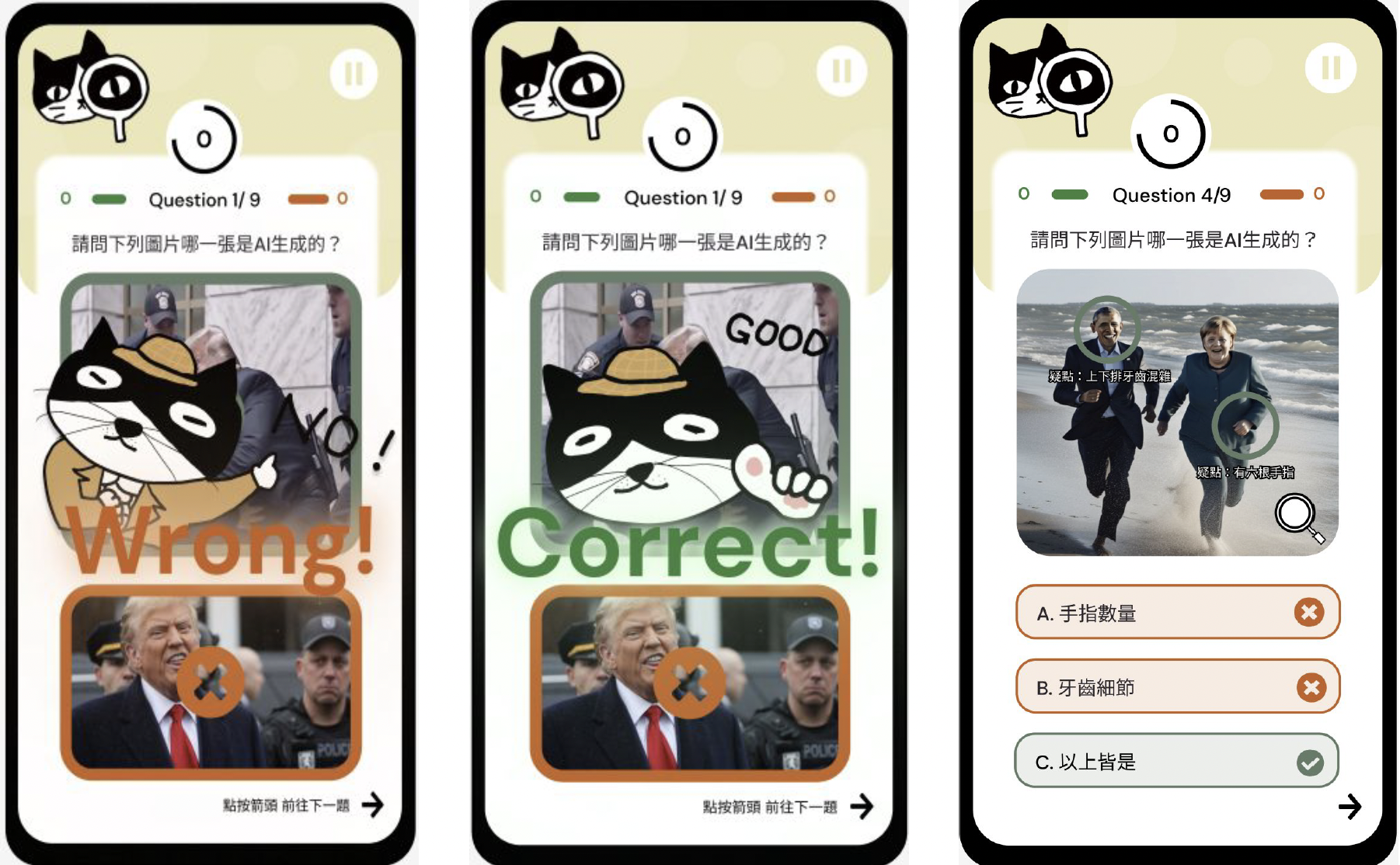
The prototype consists of a mobile-first web game with the following structure:
① Progressive Game Levels
① Progressive Game Levels
- Scenarios range from basic to advanced difficulty
- Players answer questions based on images, headlines, and contextual clues
- Guided prompts introduce techniques such as reverse image search and source comparison
- Players learn by applying methods, not memorizing rules
- Correctness is shown instantly
- Explanations clarify why an answer is right or wrong
- Scores and detective levels reflect users’ fact-checking ability
- Results can be shared, encouraging peer discussion and awareness
05 Test — Evaluation & Impact
We conducted multiple rounds of testing (N = 4 → 8 → 38) to evaluate effectiveness:
- 82% of users reported improved understanding of fact-checking concepts
- 84% felt more familiar with fact-checking methods and tools
- 87% gained better awareness of available fact-checking platforms
- 74% reported increased willingness to perform fact-checking in the future